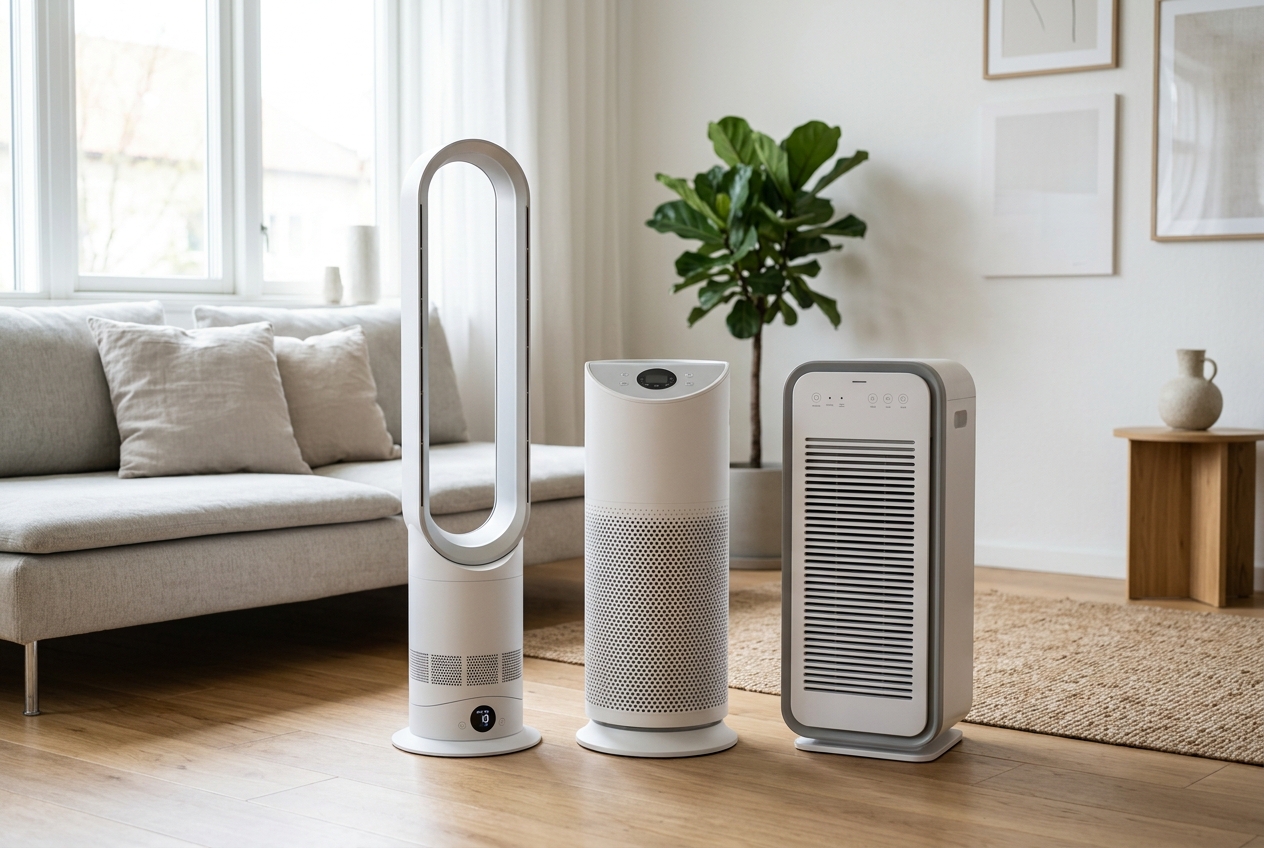
Affiliate Disclosure: AirFilterGeek participates in the Amazon Services LLC Associates Program. We earn commissions from qualifying purchases through our Amazon links at no extra cost to you. We recommend products based on specifications, performance, and value, not commission rates.
| Model | CADR (Smoke) | Coverage (4.8 ACH) | Price | Best For | Buy |
|---|---|---|---|---|---|
| Levoit Core 600S Best Overall Value |
391 CFM (AHAM verified) | ~606 sq ft | ~$299 | Smart features, large rooms, budget-conscious buyers | Check Price on Amazon |
| Coway Airmega 400 Best for Quiet + Longevity |
328 CFM (AHAM verified) | ~508 sq ft | ~$349 | Quiet operation, odor control, long-term reliability | Check Price on Amazon |
| Coway Airmega 400S Best Coway with Smart |
328 CFM (AHAM verified) | ~508 sq ft | ~$450 | Same performance + Wi-Fi, app, Alexa/Google | Check Price on Amazon |
| Dyson BP04 Best for Formaldehyde |
~193 CFM (RTINGS tested) | ~302 sq ft | ~$899 | New construction, formaldehyde concerns, design-forward buyers | Check Price on Amazon |
The air purifier market has a version of the watch problem: a $300 watch tells time exactly as well as a $3,000 watch, but the $3,000 watch exists and sells. The Dyson Purifier Big+Quiet BP04 is currently priced at $899. The Levoit Core 600S is $299. Both are air purifiers for large rooms. The question every buyer asks is whether the $600 gap buys meaningfully better air, or whether it buys design, brand, and a technology story.
The data answers this cleanly, and the answer has a conditional attached to it. For 95% of buyers, the Levoit Core 600S or Coway Airmega 400 delivers equal or better independently verified particle-removal performance at a fraction of the cost. For the remaining 5% - people dealing with documented formaldehyde off-gassing from new construction, fresh renovation, or new furniture - the Dyson's unique solid-state catalytic formaldehyde filter genuinely does something neither competitor can match. This guide walks through both cases with the numbers that actually matter.
The CADR Reality Check: What the Numbers Actually Show
CADR (Clean Air Delivery Rate) is the one number that cuts through marketing in the air purifier space. It is independently tested by AHAM (Association of Home Appliance Manufacturers) and measures cubic feet of clean air delivered per minute for smoke, dust, and pollen. Two of the three units in this comparison have AHAM certification. The Dyson does not.
Here is what the verified data shows:
| Specification | Dyson BP04 | Levoit Core 600S | Coway Airmega 400 |
|---|---|---|---|
| CADR - Smoke | ~193 CFM (RTINGS lab test) | 391 CFM (AHAM verified) | 328 CFM (AHAM verified) |
| CADR - Pollen | Not published | 436 CFM (AHAM verified) | 400 CFM (AHAM verified) |
| Coverage at 4.8 ACH | ~302 sq ft (RTINGS) | ~606 sq ft | ~508 sq ft |
| Coverage at 2 ACH | "Extra-large rooms" (Dyson claim) | ~1,588 sq ft (Levoit claim) | ~1,560 sq ft (Coway claim) |
| AHAM Certification | No | Yes | Yes |
| Noise - Low Speed | Not published (Dyson: "50% quieter than prior") | 26 dB (sleep mode) | 22 dB (low speed) |
| Noise - Max Speed | Not published | 55 dB | 52 dB |
| Price | ~$899 | ~$299 | ~$349 |
| CADR per Dollar | ~0.21 CFM/$ | ~1.30 CFM/$ | ~0.94 CFM/$ |
The Dyson BP04 delivers roughly 0.21 CFM of independently verified CADR per dollar spent. The Levoit Core 600S delivers 1.30 CFM per dollar. That is a 6x difference in verified air-cleaning output per dollar. The Coway Airmega 400 delivers 0.94 CFM per dollar. Both competitors outperform the Dyson on this metric by a wide margin.
Why does this matter? Because Dyson markets the BP04 as a large-room purifier for spaces "up to 2,830 sq ft." That figure uses an air-change methodology well below the AHAM standard of 4.8 ACH. At the allergy-relief standard of 4.8 ACH, RTINGS' independent lab data puts the BP04 at approximately 302 sq ft - the size of a medium bedroom. This is not a flaw in the engineering. The Dyson is genuinely quieter and cleaner at low speeds than many competitors. But the coverage claims require scrutiny that Dyson's own marketing does not invite.
Filtration Technology: Where Dyson Has a Genuine Advantage
Particle filtration - HEPA - is functionally equivalent across all three units. True HEPA at H13 grade captures 99.97% or better of particles at 0.3 microns regardless of brand. The meaningful filtration differences are in what happens to gases, VOCs, and formaldehyde.
Dyson BP04: The SCO Formaldehyde Cell
The Dyson BP04's standout feature is its solid-state catalytic oxidation (SCO) cell - a manganese dioxide catalyst bed that breaks formaldehyde molecules into CO2 and water at room temperature. Unlike activated carbon, which physically adsorbs formaldehyde until the carbon bed saturates and requires replacement, the SCO cell is permanent and self-regenerating. It does not need replacement. It does not become less effective over time. This is genuinely differentiating technology. No purifier at this price from Levoit or Coway matches it.
Formaldehyde off-gassing is a real concern in specific scenarios: newly constructed homes (adhesives in engineered wood flooring and MDF), freshly renovated spaces (new paint, new cabinets), and homes with new upholstered furniture (particularly foam-padded items). Peak off-gassing typically occurs in the first 6-18 months after installation. If your situation matches this description, the Dyson BP04's SCO cell is not a marketing feature - it is a meaningful air quality intervention that neither the Levoit nor the Coway can replicate.
Levoit Core 600S: 3-Stage True HEPA with Custom Carbon
The Levoit Core 600S uses a 3-stage system: washable pre-filter, H13 True HEPA, and a custom activated carbon layer. The carbon handles VOCs, cooking odors, and pet odors adequately for most households. It does not destroy formaldehyde - it adsorbs it, and the carbon layer will eventually saturate and require replacement. For normal residential VOC loads (cooking, cleaning products, off-gassing from existing furniture), this is fully adequate. Annual filter replacement runs approximately $80 per year.
Coway Airmega 400: Dual Max2 HyperCaptive Filtration
The Coway Airmega 400 uses a dual-sided intake design with two complete Max2 filter cartridges - one on each side of the unit. Each cartridge combines activated carbon and Green True HEPA filtration. The dual configuration doubles the filter surface area, which contributes to the Coway's notably quiet operation at low speeds (22 dB) despite its high CADR output. The two-cartridge system runs approximately $130 per year in filter costs - the highest of the three. However, Coway's Max2 replacement sets frequently go on sale for $75-90, and there is no DRM or proprietary locking that requires Coway-branded replacements.
| Filtration Spec | Dyson BP04 | Levoit Core 600S | Coway Airmega 400 |
|---|---|---|---|
| HEPA Grade | H13 (360-degree filter) | H13 True HEPA | Green True HEPA (dual) |
| Carbon Stage | K-Carbon filter (2-yr life) | Custom activated carbon | Pelletized activated carbon (dual Max2) |
| Formaldehyde | SCO cell - permanent destruction | Adsorbs via carbon (limited) | Adsorbs via carbon (limited) |
| Pre-Filter | Integrated | Washable | Washable (both sides) |
| Filter Life | K-Carbon: ~2 years; SCO: permanent | 6-12 months | 12 months |
| Annual Filter Cost | ~$100 (K-Carbon amortized 2-yr) | ~$80 | ~$130 (sale price ~$85-90) |
5-Year Total Cost of Ownership
Purchase price is a fraction of the real cost of owning an air purifier you run continuously. Filter replacement and electricity are the ongoing costs that determine whether a "budget" unit was actually cheaper over time.
| Cost Item | Dyson BP04 | Levoit Core 600S | Coway Airmega 400 |
|---|---|---|---|
| Purchase Price | $899 | $299 | $349 |
| Filters - Year 1-5 Total | ~$400 (K-Carbon x2 replacements) | ~$400 ($80/yr x 5) | ~$650 ($130/yr x 5) |
| Electricity - 5 Year Est. | ~$150-175 | ~$115-130 | ~$145-165 |
| 5-Year Total | ~$1,450-$1,475 | ~$815-$830 | ~$1,145-$1,165 |
| Cost Advantage vs Dyson | Baseline | Save ~$640 over 5 years | Save ~$310 over 5 years |
The Levoit Core 600S saves approximately $640 over 5 years compared to the Dyson BP04, while delivering higher verified CADR for particle removal. The Coway Airmega 400 saves approximately $310 over 5 years vs the Dyson despite the higher filter cost, because the purchase price gap is large. Both competitors deliver better CADR-per-dollar over a 5-year window. The Dyson's cost advantage from the permanent SCO cell (no formaldehyde filter replacement) and the 2-year K-Carbon life partially offsets the premium, but does not close the gap with the Levoit.
Note: electricity estimates assume running at medium speed approximately 12 hours per day at the US average rate of $0.17/kWh. Dyson's electricity draw at the same usage pattern is estimated based on reported watt draw for comparable Dyson tower purifiers. Filter costs use list prices; Coway Max2 on-sale pricing of ~$85-90 per set would reduce the Coway's 5-year filter cost to approximately $425-450, closing the gap further.
Smart Features and App Control
All three brands offer app-controlled versions of their purifiers. The implementations differ enough to matter:
Dyson MyDyson App
The BP04 integrates with Dyson's MyDyson app and supports Alexa, Google Home, and Siri. The app provides real-time air quality data from the BP04's particulate and chemical sensors, shows historical air quality charts, allows fan speed scheduling, and enables remote control when away from home. Dyson's app is generally well-regarded for polish and data visualization. The BP04 also supports 10 discrete fan speed settings and 50-degree oscillation, giving you finer control than a 4-speed Coway.
Levoit VeSync App
The Levoit Core 600S connects via the VeSync app with Alexa and Google Assistant support. The AirSight Plus PM2.5 sensor feeds real-time air quality data to the app. Auto mode adjusts fan speed based on the PM2.5 reading, and you can set daily schedules and view usage history. The interface is functional and responsive. Wi-Fi setup is straightforward on 2.4 GHz networks. If you already use other Levoit or VeSync-connected products, the Core 600S integrates into an existing ecosystem.
Coway IoCare App (400S only)
The base Coway Airmega 400 has no Wi-Fi capability. The Airmega 400S adds the IoCare app at a price premium of approximately $100 over the base 400. The IoCare app provides real-time AQI monitoring, remote control, scheduling, filter life tracking, and Alexa and Google Home integration. If smart home integration matters to you and you are choosing Coway, budget for the 400S rather than the base 400. The performance - CADR, coverage, filtration, noise level - is identical across both models; the 400S purely adds connectivity.
| Smart Feature | Dyson BP04 | Levoit Core 600S | Coway 400S |
|---|---|---|---|
| App Control | MyDyson app | VeSync app | IoCare app |
| Alexa | Yes | Yes | Yes |
| Google Home | Yes | Yes | Yes |
| Siri / Apple | Yes | No | No |
| Air Quality Sensor | Particulate + chemical | PM2.5 (AirSight Plus) | Particle + gas (base 400) |
| Scheduling | Yes | Yes | Yes |
| Fan Speeds | 10 | Multiple + Auto + Sleep | 4 + Auto + Eco |
| Oscillation | 50 degrees | No | No |
The Dyson wins on smart feature breadth - Siri support, oscillation, and 10 fan speeds give it a more complete smart home and manual-control story. For Apple HomeKit households, the BP04 is the only unit of the three with native Siri integration. For Alexa or Google Home households, all three (or the 400S specifically) are equivalent on voice control.
Who Should Buy Which: The 2026 Decision Guide
Buy the Levoit Core 600S if:
- You want the highest verified particle CADR at the lowest price - 391 CFM for $299
- You have a large room or open plan above 400 sq ft and need airflow to match
- App control, scheduling, or Alexa/Google integration matters to you
- Total cost of ownership over 5 years is a deciding factor
- You want Energy Star certified, smart, efficient filtration without premium brand pricing
Buy the Coway Airmega 400 (base) if:
- Noise at low speed is a priority - 22 dB makes this the quietest large-room unit of the three
- You run it 24/7 in a bedroom and want proven long-term reliability (5-year motor warranty)
- You want strong odor control from a dual-carbon cartridge design without smart features
- You prefer a no-frills, no-app setup with a physical control panel and LED air quality ring
- You can catch the Max2 filter sets on sale ($85-90) to reduce the annual filter cost
Buy the Coway Airmega 400S if:
- You want the Coway's performance profile with app control and voice integration added
- You use Alexa or Google Home and want remote scheduling and air quality monitoring
- The $100 upgrade over the base 400 fits your budget
Buy the Dyson BP04 if:
- Your home is newly constructed or recently renovated and formaldehyde off-gassing from MDF, adhesives, or new flooring is a documented concern
- You have new furniture (especially foam-padded upholstery) in the space and want continuous formaldehyde destruction rather than carbon adsorption
- You are in an Apple HomeKit household and want native Siri integration
- Budget is genuinely not a constraint and you prefer Dyson's industrial design and ecosystem
- You understand the CADR tradeoffs and are specifically buying for VOC/formaldehyde control, not maximum particle removal per dollar
The Dyson BP04 is the best air purifier for formaldehyde. The Levoit Core 600S is the best air purifier for particle removal per dollar. The Coway Airmega 400 is the best air purifier for quiet, reliable, long-term use. Most buyers should stop reading at the Levoit.
How to Choose the Right Air Purifier for Your Situation
Step 1: Identify Your Primary Pollutant
Particles - pollen, dust, pet dander, wildfire smoke PM2.5 - are handled effectively by any true HEPA purifier with adequate CADR for your room. If particles are your concern, CADR wins and the Levoit Core 600S leads this comparison by a significant margin. VOCs and cooking odors are handled by activated carbon in all three units - the Coway's dual cartridge system provides slightly more carbon mass than the Levoit's single filter. Formaldehyde specifically requires either carbon replacement every 6-12 months (Levoit, Coway) or the Dyson's permanent SCO cell. If you do not know you have a formaldehyde problem, you almost certainly do not have a formaldehyde problem that justifies $899.
Step 2: Size the Unit to Your Room Correctly
Use the AHAM 4.8 ACH coverage number, not the marketing coverage number. Any unit in this comparison will give you impressive-sounding square footage at 2 air changes per hour. For meaningful air quality - the kind that reduces allergen concentrations by 90%+ - you need 4-5 air changes per hour. At that standard: Levoit Core 600S covers ~606 sq ft, Coway Airmega 400 covers ~508 sq ft, Dyson BP04 covers ~302 sq ft per independent RTINGS testing. If your space is 500-600 sq ft, the Levoit is the only unit of the three that definitively covers it at allergy-relief standards.
Step 3: Run the 5-Year Math
Add purchase price, annual filter cost x 5, and electricity cost. The gap between the Levoit and the Dyson is approximately $640 over 5 years in the Levoit's favor. That is real money. For many buyers, that $640 represents an additional Levoit Core 600S for a second room - doubling coverage rather than spending more to cover less.
Step 4: Decide on Smart Features Once
Smart features are genuinely useful if you have a schedule that varies (travel, seasonal allergy periods, kids home from school) and you want to automate pre-cleaning before you arrive. If you set it, forget it, and check the filter indicator once a year, smart features add nothing. The Levoit and Coway 400S both deliver full Alexa and Google Home integration at a combined price well below the Dyson BP04 alone.
Frequently Asked Questions
Is the Dyson air purifier worth the $900 price tag?
What CADR does the Dyson Purifier Big+Quiet BP04 actually deliver?
Levoit Core 600S vs Coway Airmega 400: which is better?
Does the Dyson BP04 actually destroy formaldehyde?
What is the 5-year total cost of each air purifier?
Which air purifier is best for large open-plan spaces?
Is Dyson quieter than Levoit and Coway?
The 2026 Verdict
For the vast majority of buyers asking whether Dyson is worth the price versus Levoit and Coway, the answer is no - not on particle removal per dollar, not on coverage area per dollar, and not on 5-year cost of ownership. The Levoit Core 600S at $299 delivers AHAM-verified CADR that is more than twice the independently measured output of the Dyson BP04, covers a larger room, adds Wi-Fi and voice control, and saves $640 over 5 years. That is a decisive outcome.
The Coway Airmega 400 sits between them: quieter than either at 22 dB, with a proven reliability record and 5-year warranty, at a 5-year total cost of roughly $1,150 - meaningfully less than the Dyson and comparable to the Levoit when on-sale filter pricing is factored in. For buyers who prioritize whisper-quiet overnight operation and do not want to manage an app, the Coway is worth the modest premium over the Levoit.
The Dyson BP04 earns its $899 in one specific scenario: new construction or fresh renovation where formaldehyde off-gassing is a real, present concern and you want continuous molecular destruction rather than carbon adsorption. In that scenario, no competitor at any price matches its SCO cell. Outside that scenario, it is an excellent purifier with strong smart features and beautiful design - but it is priced for the brand story rather than the filtration data.
For more on filter technology, see our HEPA vs. Carbon Filter breakdown. For broader large-room coverage options, see our Best Air Purifiers for Home guide. For a direct look at how Coway models stack up against each other internally, read our Coway vs Levoit comparison.
Affiliate Disclosure: AirFilterGeek participates in the Amazon Services LLC Associates Program, an affiliate advertising program designed to provide a means for sites to earn commissions by linking to Amazon.com. We earn commissions from qualifying purchases made through our Amazon links at no additional cost to you. These commissions support our research, testing, and content creation. We recommend products based on specifications, performance, and value, not commission rates. As an Amazon Associate I earn from qualifying purchases.
Photos provided by Pexels.