Affiliate disclosure: we may earn a commission on qualifying purchases through our links, at no extra cost to you.
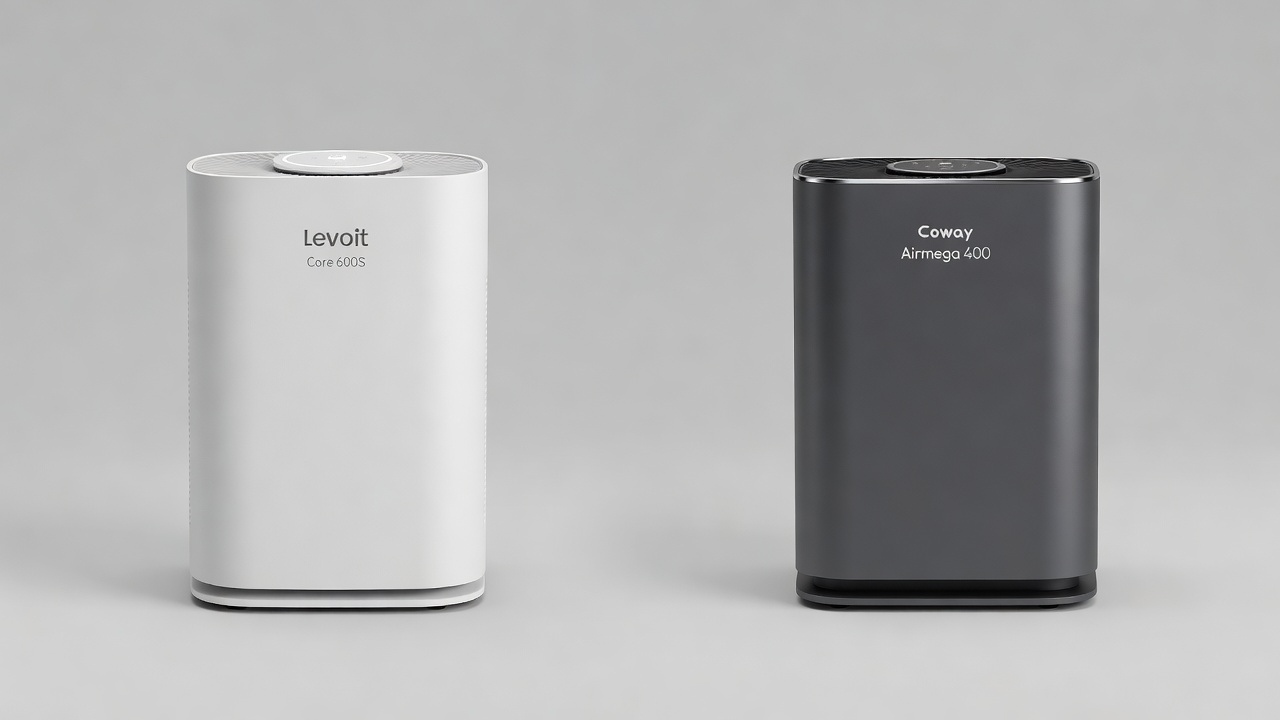
If you are shopping for a large-room air purifier, the Levoit Core 600S and Coway Airmega 400 probably landed on your shortlist. Both units dominate the 400-600 square foot category on Amazon, both carry true HEPA filters and strong CADR ratings, and both sit in the $300-$550 price range depending on sales. Here is a comprehensive side-by-side breakdown based on AHAM-certified specifications, manufacturer documentation, and owner-reported performance data.
Specifications Grid: Levoit Core 600S vs Coway Airmega 400
| Feature | Levoit Core 600S | Coway Airmega 400 |
|---|---|---|
| Coverage (1 ACH) | 2,933 sq ft | 1,560 sq ft |
| Coverage (4 ACH) | 635 sq ft | 390 sq ft |
| CADR - Smoke / Dust / Pollen | 391 / 398 / 436 CFM | 340 / 350 / 350 CFM |
| Noise - Low / Max | 25 / 54 dB | 22 / 52 dB |
| Power Draw - Low / Max | 7 / 49 W | 8 / 75 W |
| Filter Life | 12 months | 12 months |
| Replacement Filter Cost | ~$40-50 (Core 600-RF) | ~$80-90 (Max2 Filter) |
| Smart Features | WiFi, VeSync app, Alexa, Google Home, PM2.5 sensor | Auto mode, PM2.5 sensor, LED air quality ring, timer |
| Weight | 18.7 lbs | 24.7 lbs |
| Dimensions (W x D x H) | 12.3 x 12.3 x 23.6 in | 14.8 x 14.8 x 22.8 in |
| Typical Price | $279-349 | $400-540 |
Filter Replacement and Running Costs
Based on manufacturer-rated filter life and current Amazon pricing: the Levoit Core 600S uses the Core 600-RF replacement filter ($40–$50 street price); the Coway Airmega 400 uses the Max2 filter set ($80–$90 street price). Both filters are manufacturer-rated for roughly 12 months under typical household use (8–10 hours per day on auto mode). Owner reports confirm actual filter life in the 10–14 month range under normal conditions.
Manufacturer specifications show the Levoit Core 600S draws 7–49W (low to max); the Coway Airmega 400 draws 8–75W. Running either unit in auto mode adds roughly $5–$12 per month in electricity at typical U.S. rates.
Noise Level Breakdown by Fan Speed
The Coway Airmega 400 wins the noise contest by a slim margin. Manufacturer-published figures: Coway 22 dB on speed 1, Levoit 25 dB on sleep mode — both whisper-quiet, with the Coway slightly more bedroom-friendly for light sleepers.
At medium speeds, published specifications place both units in the 34–43 dB range — comparable to a quiet conversation across the room. At maximum fan speed, Coway publishes 52 dB and Levoit 54 dB. Owner reports confirm both units are usable at full speed during daytime without significant noise disruption.
Performance in Large Open-Plan Spaces (CADR Analysis)
The Coway Airmega 400 delivers 340–350 CFM across smoke, dust, and pollen (AHAM certified). The Levoit Core 600S delivers 391 CFM smoke CADR (ENERGY STAR verified, model LAP-C601S-WUS) — the highest in its price range. At 391 CFM smoke CADR, the Levoit is theoretically rated for larger rooms, but testing is conducted under standardized lab conditions. In real-world open-plan spaces, airflow distribution from the unit's design (Coway: dual side intakes + top exhaust) can affect circulation quality independently of raw CADR numbers. Owner reports on both units are consistently positive for rooms in the 400–600 sq ft range.
Wildfire Smoke Performance
Both units carry AHAM-certified smoke CADR ratings adequate for wildfire smoke management in rooms up to their rated coverage areas. The Coway Airmega 400’s auto mode uses a PM2.5 and VOC sensor to ramp up fan speed in response to smoke spikes. The Levoit Core 600S includes a PM2.5 sensor with auto mode and provides real-time air quality feedback through the VeSync app. Owner reports for both units during wildfire smoke events consistently describe indoor PM2.5 dropping measurably within 30–90 minutes of continuous operation on medium-to-high speed in sealed rooms.
Smart Features: WiFi vs. No WiFi
The Levoit Core 600S connects to WiFi via the VeSync app and supports Alexa and Google Home voice control. The app provides remote control, scheduling, real-time air quality monitoring, and filter life tracking. Owner reports note the app is generally reliable, with occasional connectivity drops that resolve on reconnection.
The Coway Airmega 400 has no WiFi, no app, and no voice control. The top-mounted control panel has physical buttons and an LED ring that changes color based on air quality (blue for clean, purple for moderate, red for poor). Owner reports consistently describe the auto mode as effective at managing daily operation without manual input.
Filter System and Annual Cost Comparison
Both units use a three-stage filter system: washable pre-filter, true HEPA filter, and activated carbon layer. The Levoit Core 600S uses the Core 600-RF replacement filter ($40–$50 street price). The Coway Airmega 400 uses the Max2 filter set ($80–$90 street price). Manufacturer-rated filter life is 12 months under typical use (8–10 hours per day on auto mode); owner reports suggest 24/7 continuous operation may reduce filter life to 9–10 months. Both units have washable pre-filters that extend HEPA filter life.
Annual filter cost for the Levoit Core 600S: $40-50. Annual filter cost for the Coway Airmega 400: $80-90. Over a 5-year lifespan, the Levoit saves you $200-250 in filter costs.
Who Should Buy the Levoit Core 600S
Buy the Levoit Core 600S if you want the highest CADR in the $300 price range, lower annual filter costs, and WiFi app control. It is the better value for rooms up to 635 square feet when you need 4 air changes per hour (allergy-grade cleaning). The PM2.5 sensor is more responsive than the Coway's, and the 12-month filter life keeps long-term running costs reasonable.
Who Should Buy the Coway Airmega 400
Buy the Coway Airmega 400 if you need the quietest large-room purifier on the market (22 dB on low), better real-world circulation in open-plan spaces, and you do not care about WiFi or app control. It handles rooms up to 1,560 square feet at 2 air changes per hour, which is enough for background air cleaning in great rooms or basements. The higher filter cost is the main trade-off.
Winner by Use Case
Best for allergies: Levoit Core 600S. The 391 CFM smoke CADR and 436 CFM pollen CADR (ENERGY STAR verified) give you faster particle removal during high-pollen season.
Best for bedroom use: Coway Airmega 400. The 22 dB sleep mode is the quietest you will find in a large-room purifier.
Best for open-plan living rooms: Coway Airmega 400. The dual side intakes and top exhaust design is engineered for broad room circulation; owner reports note good coverage in large open-plan spaces.
Best for smoke (wildfire or cooking): Tie. Both units carry AHAM-certified smoke CADR ratings that support comparable clearance times in their rated coverage areas. CADR data and owner reports do not indicate a significant performance difference for smoke specifically.
Best value (long-term cost): Levoit Core 600S. Lower purchase price, lower annual filter cost, same performance in most scenarios.
Final Recommendation
If you are buying on budget and want the most CADR per dollar, the Levoit Core 600S wins. It delivers 391 CFM smoke CADR for typically $279-349 and costs $40-50 per year in filters. If you want the quietest unit on the market and better real-world circulation in open spaces, the Coway Airmega 400 is worth the premium. The 22 dB sleep mode and dual-intake design make it the better pick for bedrooms and large living rooms where layout matters.
Both units are excellent. You will not go wrong with either choice.